
The USS John Paul Jones acted like a dog marking the lamp post, observes Ambassador M K Bhadrakumar.

'Progress demands regular senior-level attention from American leaders.' 'A leaders' summit is great, but we need sustained engagement to continue to forge new agreements and find new areas of cooperation.'

'I hope that the incoming Biden-Harris Administration works with India to address some of the most profound geopolitical transboundary challenges.'

The unmanned aerial vehicle has been developed for surveillance and broadcasting and is ready for commercialisation.
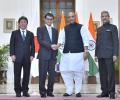
The India-Japan 2+2 dialogue added strategic heft to the special relationship in the wake of growing Chinese assertiveness on regional affairs, points out Dr Rajaram Panda.

During their talks, the two leaders decided to significantly expand their ties in several key areas including defence, trade, energy and education.

In a strong message to China, India and ASEAN on Thursday called for a "full and effective" implementation of the understanding between the parties involved in the South China Sea dispute, while stressing on maritime security and freedom of navigation in the critical sea lanes.
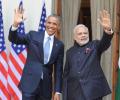
The US wants its trade with India to grow multi-fold, Assistant Secretary of State for South and Central Asia Nisha Desai Biswal told lawmakers.

India and the US also made a strong push for the intra-Afghan peace process to end violence in Afghanistan and ensure that it does not become home to terrorism, and vowed to deepen cooperation in the Indo-Pacific and on COVID-19 response and economic recovery.

Israel is determined to take the bilateral engagement to a different level that goes beyond defence hardware and intelligence software. Kanchan Gupta reports exclusively from Tel Aviv for Rediff.com

'India has ramped up infrastructure on its side, so the Chinese military is finding Indian soldiers in locations where they are not used to seeing an Indian footprint,' points out Harsh V Pant.

Japan could soon be the second country after the US with which India has a logistics support agreement. Besides the LSA, India and Japan may also sign a maritime domain awareness agreement which would enable the two navies to share information. For example, if a Japanese P-1 maritime patrol aircraft detects a Chinese submarine in the Indian Ocean, it would pass on the information to the Indian Navy, reveals Ajai Shukla.
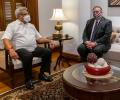
Pompeo, who became the Trump administration's highest ranking official to visit Sri Lanka, said that the US and Sri Lanka shared a vision for democracy to build a relationship and the "freedom to hold democratic elections".

Prime Minister Modi will hold bilateral meetings with President Paul Kagame, delegation-level talks and meetings with the business and the Indian communities, a statement from the Prime Minister's Office said.

Mattis said there can be 'no tolerance to terrorism safe havens'.

He said both countries are opening new areas of cooperation in the energy sector, telecommunications and science and technology and they have set up funds to facilitate investment in high technologies.

Tillerson said China's behaviour and action is "posing a challenge to the rules-based international order".

A framework agreement on Jaitapur Nuclear Power Project (JNPP) is expected to be signed between the two sides during the visit.

'China is constantly probing India's weaknesses.' 'The challenge is to implement a strategy that will allow India to buy time, gather its strength, and eventually counter China,' recommends Harsh V Pant and Vinay Kaura.

The Indian High Commission made its displeasure known despite the British government earlier reiterating that the three New Delhi laws on agricultural reform were a "domestic matter".

The latest announcement was made by the US Defence Secretary Jim Mattis during the change of guard ceremony at Joint Base Pearl Harbour wherein Admiral Phil Davidson replaced Admiral Harry Harris as Commander, US Indo-Pacific Command or IndoPacom.

'Modi's initial forays into foreign policy had the flavour of Aswamedha Yagas launched by ancient kings to conquer the world.' 'He overcame the hesitations of history and explored unconventional ways to win friends and influence people.' A fascinating excerpt from Ambassador T P Sreenivasan's new book, Modiplomacy -- Through a Shakespearean Prism.

Prime Minister Narendra Modi has favoured broadening of the strategic partnership with Russia in nuclear, defence and energy sectors and invited President Vladimir Putin to visit Kudankulam atomic power project during his trip in December for his annual summit.
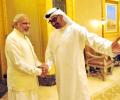
Apart from key bilateral issues, the two leaders also discussed situation in the region, particularly in wake of the increasing threat of terrorism and extremism from various sources including the Islamic State militant group.

We have seen great strides in all-around cooperation, Chinese foreign ministry spokesperson said.

Describing the unprecedented second visit of US President Barack Obama to India as "game changing" the White House has said the Obama-Modi meeting would "elevate the nature of the relationship" between the two largest democracies of the world.
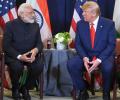
The US President also encouraged Prime Minister Modi to improve relations with Pakistan.

"Welcome to India, President @EmmanuelMacron! Your visit will add great strength to the strategic partnership between India and France. I look forward to our talks tomorrow," Modi tweeted after receiving Macron at the airport.

A business in India wanting access to maps and geospatial data would typically have to wait months before it got what it wanted. All this is set to change with the new guidelines on geospatial data, report Neha Alawadhi and Peerzada Abrar.
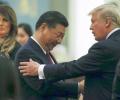
'While many Chinese policy makers dismiss the political, economic and technological component of US-India relations, they express caution on the defence-related ties which also happens to be a major driver in US-India relations,' explains China expert Srikanth Kondapalli.

'The US wants Modi to succeed because we want India to succeed. For our part, when India thinks of its partners in the world, we want it to think of the US first. That means positioning our country as the preferred provider of the key inputs that can help to propel India's rise.' 'The meeting between Modi and Obama is, and must be, an opportunity for true strategic dialogue -- not a scripted exchange of talking points, but an open discussion of the big questions. What kind of world do we want to live in? What are our true priorities? And most importantly, why does this partnership still matter?'
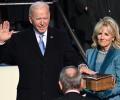
World leaders said they were looking forward to working with Joe Biden, as they welcomed the 46th President of the United States with praise and took parting shots at his predecessor Donald Trump.
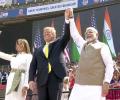
Trump's visit symbolised heightened partisanship and a return to chemistry between leaders defining bilateral ties, notes Kashish Parpiani.
Big ticket defence deals including purchase of missile systems, frigates and joint production of helicopters were sealed on Saturday.

The US is not going to be able to mount a concerted 'Western strategy' against China or Russia in the present international milieu, predicts Ambassador M K Bhadrakumar.

'She has to get the funds, cut through bureaucratic flab, speed up modernisation, ensure planned acquisitions stick to timelines, make organisational changes and ensure the military is capable of performing the task that it is given,' says Brigadier S K Chatterjee (retd).

'The military aim in a future conflict, if it can't be avoided, should be to cause maximum damage to the adversary's war waging capability and capture limited amount of territory as a bargaining counter,' says Brigadier Gurmeet Kanwal (retd).

'Analysts see BECA as a 'force multiplier' for India.' 'But China too is known to have such capabilities.' 'The military gap with China will continue to remain a fact of life, BECA notwithstanding,' argues Ambassador M K Bhadrakumar

The French president said that peace should be maintained in the region and peoples' rights should be protected.

'The past year has yielded extraordinary results in the strategic, commercial, and people-to-people components of the India-United States partnership, US Ambassador to India Richard Rahul Verma tells Aziz Haniffa/Rediff.com in an exclusive interview.
